
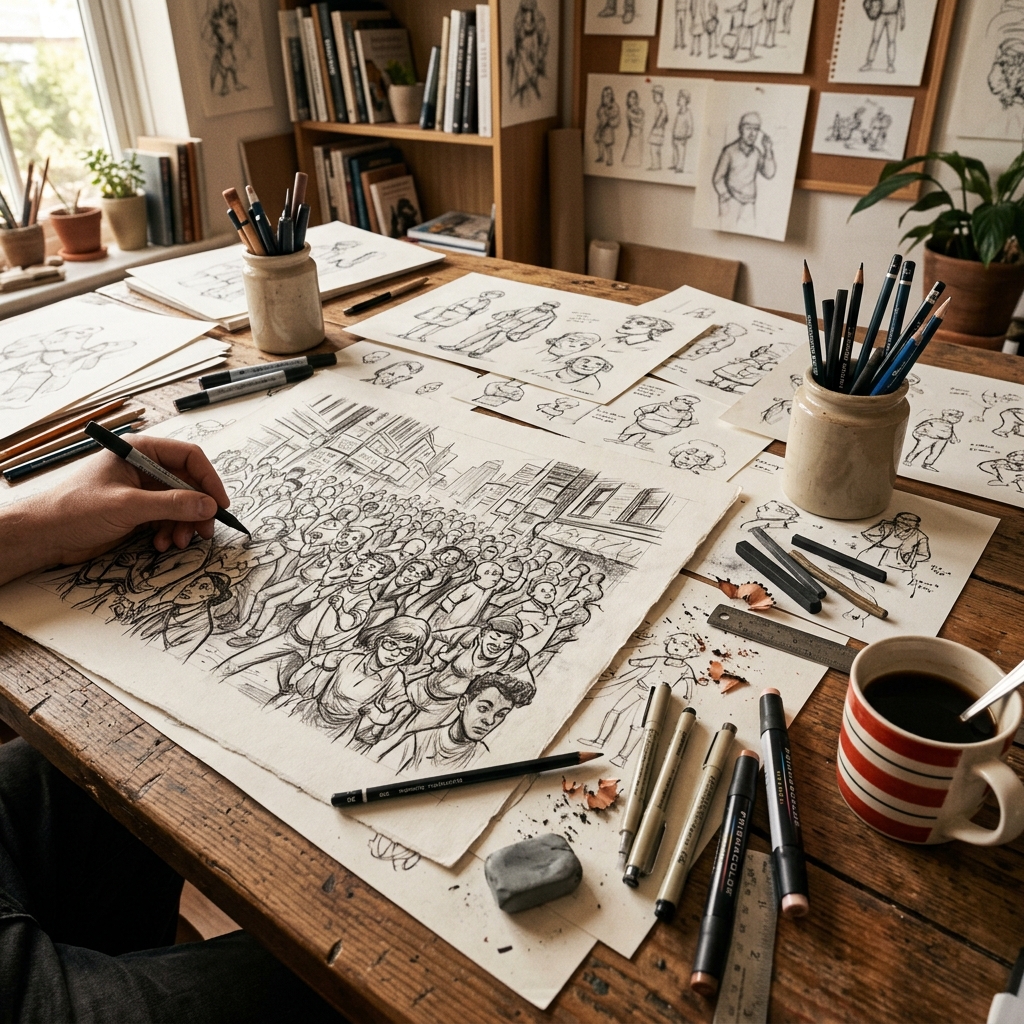
Designing a great puzzle scene takes more than just filling space with random objects. A Where’s Waldo style scene works best when every detail feels intentional, creating a balance between visual chaos and clear structure.
With the right approach, you can build scenes that are not only fun to look at but also challenging to explore. By understanding how players search and what catches their attention, you can design experiences that feel engaging from start to finish.
How to Design a Where's Waldo Style Scene
Before you draw a single line, you need a plan. A good hidden object scene is not random chaos. It is organized chaos. Every character, every object, every color serves a purpose. Some things are there to be found. Most things are there to distract. Your job is to balance both.
Step 1: Choose Your World
Every great scene starts with a setting. The setting decides everything: the characters, the colors, the objects, even the mood. Ask yourself these three questions before you put pencil to paper.
- Where does this scene take place? A beach? A castle? A space station? A school?
- What time of day is it? Morning, noon, or night? This affects your lighting and shadows.
- What is the main activity? A parade? A market? A festival? A battle?
Write down your answers. Keep them simple for your first scene. A beach is easier than a medieval fair. A park is easier than a busy airport. You can get complicated later.
Step 2: Pick Your Hidden Characters
You need at least one main target. This is your "Waldo." But you can also add secondary targets to make the scene replayable. Here is a simple system for beginners.
- Main character (hardest): 1 (e.g., A wizard with a purple hat)
- Secondary characters (medium): 3-5 (A lost cat, a broken clock, a red shoe)
- Easy finds (very easy): 5-10 (A banana, a coin, a feather)
Do not add more than this for your first scene. You will overwhelm yourself. Start small.
If you want to see a perfect example of crowd design, color balance, and clever hiding before you start drawing your own scene, go play a where's waldo game online. Study how the characters are arranged.
Step 3: Gather Your Tools
You have two paths: analog or digital. Both work.
- Analog tools: A3 or A2 paper, Fine-liner pens, Pencils, Eraser, Colored pencils or markers.
- Digital tools: A drawing tablet, Software (Photoshop, Krita, Clip Studio Paint, GIMP), Stylus.
My recommendation for beginners: Start with paper. Pencil and paper force you to think about every line.
Building Your Background: The Foundation of the Scene
The background is not just empty space. It is the stage where your crowd performs.
- Start with a Horizon Line: Everything above it is sky. Everything below it is ground.
- Add Large Landmarks: Trees. Buildings. Tents. Boats. Stages. These break up the page into sections.
- Add Depth: Background (far away), Midground (normal size), and Foreground (large characters creating a "window").
Designing Your Crowd: The Heart of the Scene
Now comes the fun part. The crowd. Professional illustrators use shortcuts.
- The Reuse Method: Create a set of 10 to 15 "base poses." Draw these same poses over and over, hanging details like hats, hair, and clothes.
- The Hat Rule: Hats are your best friend. Draw ten different hat shapes and repeat them across your crowd.
- The Rule of Three Colors: Pick three main colors plus one accent color. Limiting your palette makes the scene feel cohesive.
Hiding Your Main Character: The Art of Camouflage
You need to blend him into the chaos.
- The Partial Obscure: Place your character behind another object or person.
- The Pattern Match: Give your character a striped shirt, then put striped objects nearby.
- The Crowd Duplicate: Draw characters who look very similar.
- The Color Blend: Make your character's colors match the background.
- The Edge Hug: Place your character along the very edge of the paper.
Where NOT to hide: The exact center, all alone in an empty space, or right next to a bright, unique object.
Testing Your Hide
Before you call your scene finished, test it. Give your page to a friend. If they find it in under 20 seconds, your hide is too weak. If they take longer than 3 minutes, your hide is too strong. The sweet spot is 45 to 90 seconds.
Adding Secondary Hidden Objects
Add a list of smaller items to find. These should be easier than the main character.
- Good Secondary Objects: A coin on the ground, a lost shoe, a cat in a hat, a spilling drink.
- Bad Secondary Objects: Something the same color as everything else, something too small.
The Secret to Faces: Less Is More
Beginners spend too much time on faces. In a busy crowd, your brain fills in the details. Keep background characters faceless, midground characters with two dots and a line, and foreground characters with simple features.
Adding Humor and Small Stories
The best pages are funny. Ask yourself: "What is this character doing?" Draw people interacting—fighting over a toy, helping someone up, or sleeping while others are awake.
Conclusion
In the end, creating a successful Where’s Waldo style scene comes down to thoughtful design and attention to detail. It’s about guiding the player’s eyes while still making the search feel natural and rewarding. Start with simple ideas, experiment with different layouts, and improve as you go.