
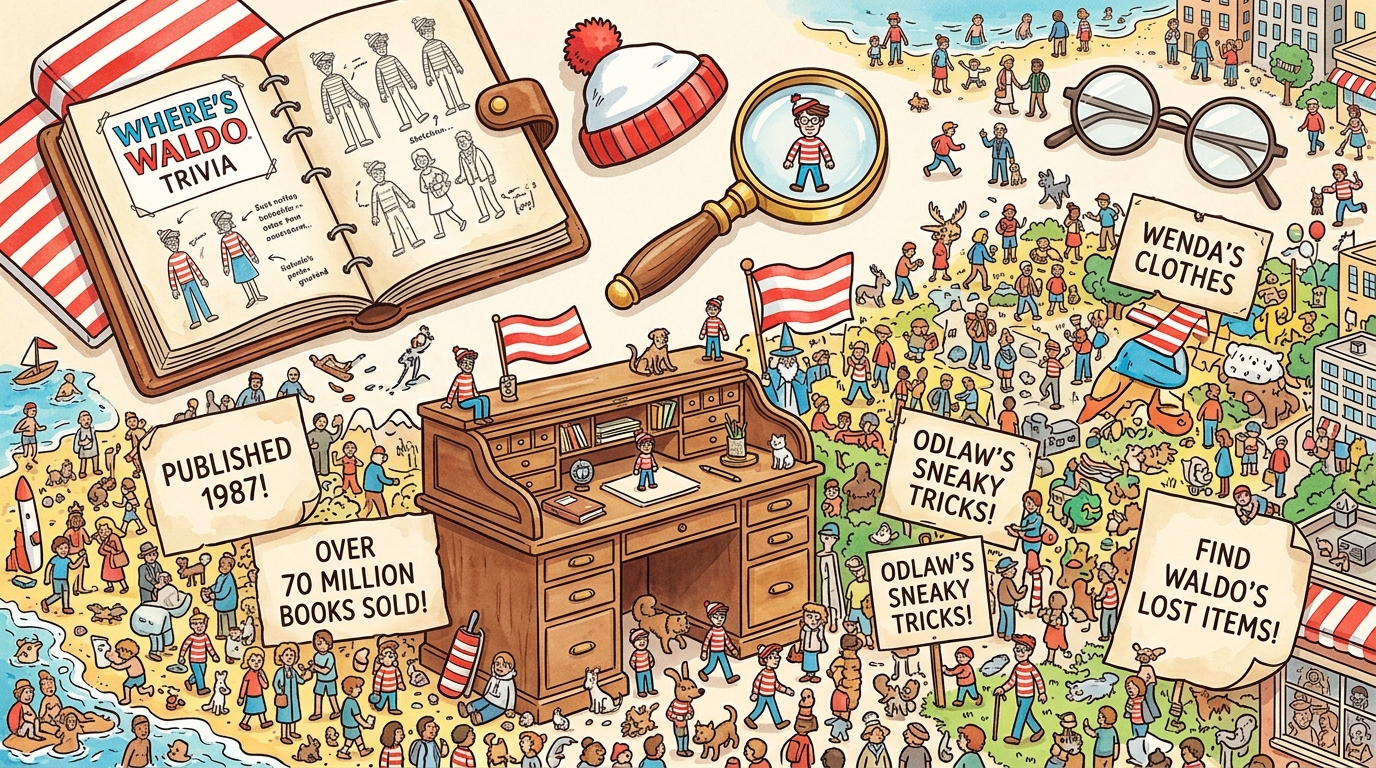
Finding Waldo is never just about spotting a red-and-white striped shirt. The crowded illustrations hide funny characters, unusual scenes, and tiny details that are easy to miss on your first look.
These interesting facts about Where’s Waldo reveal the clever ideas behind the puzzles, the story of Waldo’s name, and the characters who make each search more entertaining.
15 Interesting Facts About Where’s Waldo
1. Waldo Was Originally Called Wally
The character most American readers know as Waldo was originally introduced as Wally in the United Kingdom. The first book, Where’s Wally?, was published by Walker Books in 1987.
When the series reached the American market, the character received a different name. That is why readers in Britain often look for Wally, while readers in the United States search for Waldo. Both names refer to the same wandering character.
2. Martin Handford Created the Series
Martin Handford is the British illustrator behind the Where’s Waldo books. Before becoming famous for the series, he worked as a freelance illustrator specializing in detailed crowd scenes.
His interest in drawing groups of people helped shape the idea that eventually became Waldo. Rather than placing one character against an empty background, Handford built entire worlds filled with people, activities, and visual jokes. The reader’s job was to find one familiar figure hidden within all that activity.
3. The First Book Appeared in 1987
The original Where’s Wally? book was published on June 25, 1987. Its central idea was easy to understand: readers explored large illustrations and searched for Wally among the many people in each scene.
The format was different from a traditional storybook. Instead of following a plot from page to page, readers could spend time examining individual pictures, discovering details, and returning to scenes to find things they had missed.
4. Waldo’s Outfit Was Designed to Stand Out
Waldo’s familiar appearance includes a red-and-white striped shirt, a bobble hat, and round glasses. These features give readers a recognizable set of clues to look for in the middle of a crowded illustration.
The striped shirt is particularly useful because it creates a distinctive pattern. However, finding red and white colors alone is not always enough. Similar patterns and overlapping characters can distract readers, which is why checking his other features can help confirm a match.
5. Each Picture Contains Much More Than Waldo
Waldo is the main target, but he is rarely the only interesting character in a scene. The illustrations contain crowds of people doing different things, from ordinary everyday activities to ridiculous and imaginative antics.
That extra activity gives the books their replay value. You might find Waldo on your first attempt and then notice a funny character, an unusual costume, or a small visual joke that you completely overlooked before.
6. Creating a Single Illustration Can Take Weeks
Handford’s illustrations require careful planning and a great deal of detail. Reporting on his work has noted that a single two-page picture can take him as long as eight weeks to complete.
That time is not spent drawing Waldo alone. The entire scene needs to feel like a busy, connected world, with different characters, objects, and activities competing for the reader’s attention. Every additional detail contributes to the experience of searching the picture.
7. Waldo Became Harder to Find Over Time
An analysis of the original series found that Waldo became smaller relative to the surrounding crowd across the books. In the first book, the character occupied more space than he did in later installments.
The number of other people also increased. One comparison found roughly 225 non-Waldo figures on an early spread, compared with around 850 in the later book examined. This helps explain why experienced readers may find some later puzzles more challenging than the earliest ones.
8. His Name Changes Around the World
Waldo and Wally are not the character’s only names. Publishers have adapted his name for different languages and markets, giving international readers a version that feels familiar to them.
For example, the character is known as Walter in Germany, Charlie in France, and Ubaldo in Italy. The differences are a reminder that a book series can keep its central idea while adapting parts of its identity for readers in different countries.
9. Wenda Is One of Waldo’s Regular Companions
Wenda is an important character in the Where’s Waldo universe. Like Waldo, she has a distinctive appearance that readers can learn to recognize in the illustrations.
Finding familiar companions adds another layer to the books. Depending on the edition, readers may be asked to search for more than one character, turning a straightforward hunt into a longer activity with several things to discover.
10. Odlaw Is Waldo’s Recognizable Opposite
Odlaw is another recurring character, known for his yellow-and-black clothing. His name is a playful reversal of the letters in “Waldo.”
His contrasting outfit gives readers another character to identify while exploring the crowd. If you see a figure with a similar-looking hat or a bold pattern, looking at the clothing as a whole can help distinguish Odlaw from Waldo.
11. Woof Adds Another Search Challenge
Woof is Waldo’s dog and one of the familiar characters associated with the series. Like the human characters, he can become part of the detailed visual puzzle.
Searching for supporting characters encourages readers to look more carefully at the entire illustration. It also means the fun does not necessarily end once Waldo has been found.
12. The Books Have Expanded Beyond Picture Puzzles
The original search-and-find books inspired a much larger collection of related products. Readers can find activity books, coloring books, calendars, games, and other publications featuring Waldo and his world.
The publisher’s catalog includes formats such as Where’s Waldo? Spooky Spot the Difference and Where’s Waldo? The Great Games Speed Search. These variations bring the familiar characters into activities beyond the original hidden-character format.
13. Waldo Has Appeared on Television
The character has also moved from printed pages to animated entertainment. A television adaptation introduced Waldo’s adventures to viewers who might not have encountered the books.
Animated stories offer a different experience from a still illustration. Instead of studying one enormous picture, viewers follow characters and events as they unfold. The franchise has continued to receive new adaptations for different audiences over time.
14. The Series Has Inspired Serious Searching Experiments
Waldo’s popularity has attracted attention from people interested in visual search and pattern recognition. Researchers and data enthusiasts have examined where the character appears on the page and how readers might search for him more efficiently.
One widely discussed analysis mapped Waldo’s locations across the classic books and examined patterns in his placement. Such experiments demonstrate that a playful children's puzzle can also provide an interesting way to study how people scan crowded images.
15. The Background Jokes Are Part of the Experience
The illustrations are not just collections of people placed around a hidden character. Handford draws inspiration from films, museums, art galleries, comics, books, and other sources, using research to develop detailed scenes.
That approach helps make the backgrounds entertaining in their own right. While searching for Waldo, readers may encounter unusual costumes, funny situations, unexpected objects, and small visual stories happening elsewhere in the picture.
Quick Facts About Where’s Waldo
Why People Still Enjoy Finding Waldo
Part of the series’ appeal is that almost anyone can understand the goal, regardless of age or reading ability. You do not need to follow a complicated storyline or learn special rules before opening a book. You simply look at the picture and begin searching.
The challenge changes with every scene. One illustration might be crowded with tourists, while another contains unusual creatures, performers, or elaborate machinery. This variety gives readers a reason to slow down and examine the artwork instead of rushing through the pages.
There is also satisfaction in finding details that were missed the first time. A picture that initially looks chaotic can gradually become easier to understand as you recognize its patterns and notice individual characters.
The fun doesn't have to end with the books. If you want to test your searching skills yourself, play Where’s Waldo online and explore more crowded scenes filled with hidden details and visual surprises.
Key Takeaways
Where’s Waldo is more than a simple search game. Martin Handford’s detailed artwork, Waldo’s recognizable outfit, and memorable characters have helped make the series popular across generations.
From its original name, Wally, to the hidden jokes scattered throughout each illustration, there is always something new to discover. Next time you play, look beyond Waldo—you might find some surprising details along the way.